Without Understanding These Five National Mindsets of Laos, Your Overseas Project Is Just Self-Indulgence
Lao culture
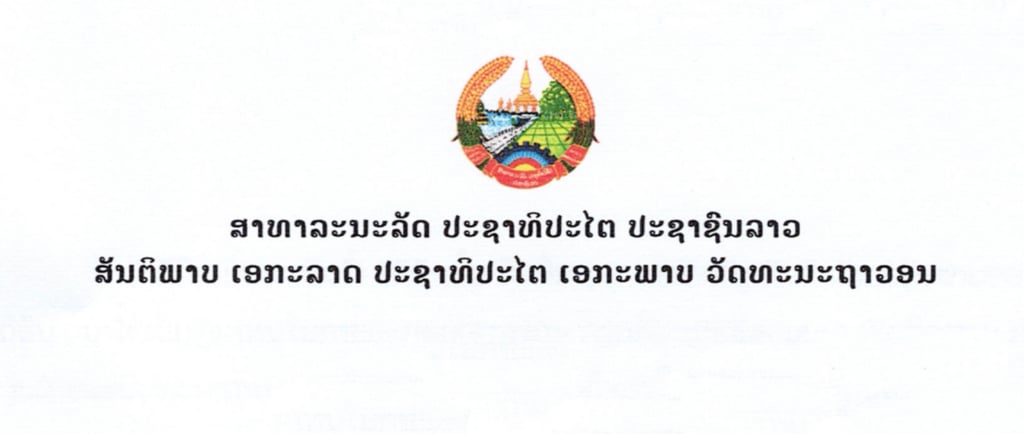
In the Lao People’s Democratic Republic, whether in official red‑header documents or legal statutes, two lines of prominent text invariably appear: the first line is the country’s name, and the second line lists five key words side by side—Peace, Independence, Democracy, Unity, and Prosperity.
For outside observers accustomed to fast‑paced modern civilisation or the Western political discourse system, these words are often easily dismissed as formulaic political slogans, or even saddled with stereotypes of a “Buddhist‑style” laid‑back attitude, underdevelopment, or sheer dependence on foreign aid. Yet behind the surface of words often lies a nation’s deepest collective memory and developmental mindset.
To truly examine these five words from Laos’s perspective, we must strip away the arrogant “other‑narrative” and place them within the context of this landlocked country’s extremely tragic historical wounds, its unique ethnic tribal structure, and its survival practices in the geopolitical cracks.
Peace (Santiphap): The bottom line of survival forged from historical trauma
To outsiders, “peace” in Laos is often associated with Theravada Buddhism’s compassion and the easy‑going, non‑contentious national character of the Lao people. But the Lao themselves know well that the foundation of this peace is not Buddhist detachment—it is blood and scorched earth.
During the Indochina Wars, this land endured the highest‑density bombing in human history—over two million tons of bombs were dropped. To this day, hundreds of millions of unexploded ordnance (UXO) remain buried across the country, continuously threatening the lives of contemporary Lao people and casting a lingering shadow over land development and agricultural modernisation.
Therefore, the word “Peace” at the top of official documents, in the deep‑seated mindset of the Lao people, equates to “the bottom line of the right to survival.” It represents a resolute determination never again to become a proxy battlefield for great‑power games. The core narrative behind Laos’s active participation in ASEAN and its deep integration into the Belt and Road Initiative is not blind pursuit of interests, but an attempt to build a secure moat through dense networks of shared interests via deep regional economic integration. Only with peace can the nation even speak of survival.
Independence (Ekalat): The “art of balanced survival” in geopolitical crevices
As a landlocked country surrounded by China, Vietnam, Thailand, Cambodia, and Myanmar, Laos has experienced regional fragmentation and colonial rule in its history, and carries an intense sense of geopolitical compression in its bones. Some external voices therefore question whether Laos is highly economically and politically dependent on its neighbours, and whether its independence is merely nominal.
However, in Lao political wisdom, “independence” has never been equated with isolation, but rather with “an autonomous narrative under great‑power balance.”
The Lao people are extremely adept at seeking dynamic equilibrium among multiple forces: politically, it maintains a traditional special solidarity relationship with Vietnam; economically, it deeply absorbs China’s infrastructure dividends and industrial transfers; in civil trade and cultural exchanges, it maintains a natural high‑frequency connection with Thailand; and at the same time, it actively absorbs international aid from Europe, the United States, Japan, South Korea, and UN agencies. Not leaning toward any single absolute power, but using the inertia of competing forces to preserve the stability of its regime and the autonomy of its decision‑making—this is precisely the path to independence that Laos has carved out in its narrow geopolitical space.
Democracy (Paxathipatai): The “logic of stability” based on consultation and ethnic inclusion
If measured by Western multiparty or electoral standards, Laos would often be misunderstood. What the Lao people understand by “democracy” is deeply embedded within the institutional framework of the “Lao People’s Democratic Republic.”
Historical lessons have taught this country that blind Western‑style freedom once exacerbated ethnic fragmentation and even triggered decades of civil war. Laos has 49 officially recognised ethnic groups, and the complexity of its social structure means that an unstable political system would be devastating to its fragile economy.
Thus, Laos’s democratic path leads toward “internal consultation, ethnic inclusion, and social harmony.” Its democracy is more manifest within mechanisms such as the National Assembly and the Lao Front for National Construction, with the core being how to balance the interests of multiple ethnicities and how to reach broad consensus through internal mechanisms. In the Lao underlying logic, the most pragmatic and nationally appropriate people’s democracy is one that avoids unnecessary upheaval and subversive social turmoil, ensuring that all classes and ethnic groups are not institutionally abandoned in the process of development.
Unity (Ekaphap): Building national identity across mountains and cultures
For a country with a population of just over 7 million, outsiders find it hard to understand why “Unity” is elevated to such a high strategic priority. However, from geographical and historical perspectives, Laos is a typical mountainous country that long experienced regional fragmentation or chieftain autonomy. Due to high mountains, long distances, and extremely underdeveloped transport, ethnic groups living at different altitudes (such as the Lao Loum, Lao Theung, and Lao Soung) historically lacked deep physical and cultural exchanges.
In Laos’s view, “Unity” is by no means merely territorial integrity—it is the thorough connection of people’s hearts and physical space.
This is precisely the fundamental driver behind the Lao government’s recent nationwide efforts to transform the country from “land‑locked” to “land‑linked.” The opening of the China‑Laos railway and the construction of north‑south expressways are seen by outsiders as economic projects, but in Laos’s national narrative, they are the hard infrastructure connectivity that breaks down geographical barriers. Only through physical connections that cross mountains and rivers can effective central governance and a genuine “national identity” among all citizens truly take root. Without spatial connectivity, there can be no true national unity.
Prosperity (Vatthanathavon): A late‑starter solution to leaving “least developed” status
As one of the long‑standing “Least Developed Countries” (LDCs) on the UN list, weak industrial systems and a shortage of medical and educational resources are the most urgent pain points for successive Lao governments. International tourists accustomed to Laos’s “slow life” often romanticise underdevelopment as a “pure Shangri‑la,” but Laos itself has an urgent aspiration for prosperity, because it knows well that without economic prosperity, the aforementioned peace, independence, democracy, and unity would all lose their material foundation.
Remarkably, Laos’s pursuit of prosperity has not blindly replicated the traditional path of “pollute first, clean up later” taken by older industrialisers, but instead demonstrates a leapfrog thinking grounded in its own endowments.
In recent years, Laos has been trying to leverage its unique resources: exporting clean hydropower as the “battery of Southeast Asia”; reshaping its regional hub status through modern logistics networks linked to cross‑border railways; and even in the digital economy, actively embracing digital payment infrastructure and exploring green ESG finance development paths. Its prosperity narrative is one of “changing lanes and overtaking” toward modernisation by utilising late‑mover advantages, while preserving ecological bottom lines and traditional culture.
When we string these five words together, a clear “national mindset map” of Laos emerges.
Peace and independence are the prerequisites and red lines for national survival; democracy (internal consultation) and unity (spatial cohesion) are the foundation and pillars of national stability; and the ultimate prosperity is the material endpoint that enables this multi‑ethnic landlocked country to truly stand firm on the international stage.
These are not just fine words on paper, but an interlocking, progressive logic of national security and development. Whether for multinational corporations planning business layouts in Laos, or for multilateral organisations designing strategic programmes there, only by truly reading this hidden “national mindset,” and by mapping their own development discourse onto Laos’s underlying aspirations for “independence, geopolitical connectivity, and green prosperity,” can they find, beyond the surface of official maxims, the true cooperative code that resonates with this country.
connect
Discover a rapidly developing Lao
info@laosbn.com
© 2025. All rights reserved.