
Rooted Between Mountains and Sea: The "Still Waters Run Deep" of Laos' Grassroots Governance
Grassroots reform
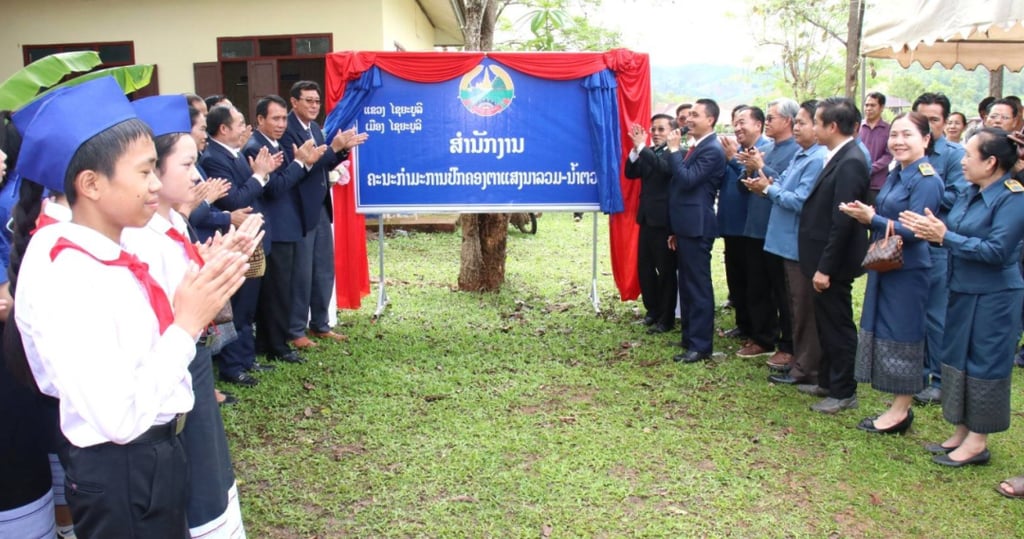
Amid the rapidly changing currents of development, the outside world often focuses its attention on Vientiane's soaring skyscrapers or the spinning wheels of cross‑border railways. Yet the most profound transformations are taking place away from the landmarks, deep in the mountain villages surrounded by the Annamite Range and the Mekong River.
Recently, two pieces of administrative news from Laos' grassroots level have quietly revealed a silent but profound shift in the country's governance system: La Mam District in Sekong Province formally announced the full establishment of four subdistrict offices, achieving full grassroots administrative coverage across the district. Shortly thereafter, Xayabury District in Xayabury Province ceremoniously inaugurated the Naluan‑Nantuan Subdistrict Office. These two moves, seemingly distant from each other, resonate on the same frequency — together they mark Laos' efforts to respond to practical challenges with institutional innovation, sinking governance solidly into the most remote lands between mountains and sea.
A Breakthrough Choice Against an Economic Headwind: Why Focus on the Grassroots?
To understand the deep significance of this shift, we must first look at the macroeconomic challenges Laos currently faces. In recent years, influenced by volatile international commodity prices, public debt pressures, and currency depreciation, the Lao economy has entered a relatively difficult adjustment period. Against this backdrop, the Lao government has clearly articulated a national strategy of "building an independent and self‑reliant economy," seeking to reduce external dependence and unlock internal potential.
However, an independent and self‑reliant economy cannot be achieved through central government policy documents alone; it requires the productive forces of every village and every farming household to be truly activated. For a long time, Laos' remote mountainous areas have suffered from a structural bottleneck: district governments are too far away and lack the administrative reach, while village committees lack coordination capacity and specialized divisions of labor. Thus, a grassroots governance reform oriented toward "strengthening foundations and sinking state power" has emerged. The establishment of subdistrict offices in La Mam and Xayabury districts is the most direct manifestation of this strategy taking root at the grassroots level.
From "Outpost Agency" to "Statutory Tier": The Institutional Leap of Kum Ban
A core administrative unit appears repeatedly in these two news items: the "Kum Ban" (meaning "village cluster" or "village group"). This is not a brand‑new invention, but a coordinating mechanism that has long existed at the grassroots level in Laos. What is notable, however, is that according to the 2025 draft amendments to the Lao Constitution, this administrative tier — sitting between district (Muang) and village (Ban) — is being formally elevated to a statutory "township‑level" unit. In other words, Kum Ban is transitioning from an ad‑hoc "outpost agency" to an institutionalized, regularized governance unit.
Take La Mam District as an example. The three newly established subdistrict offices — Vanthong, Sui, and Ongkeo — together with the previously inaugurated Xay Subdistrict Office, now form the four grassroots administrative pillars of the entire district. Among them, Vanthong Subdistrict Office governs 14 villages, Sui Subdistrict Office governs 6 villages, and Ongkeo Subdistrict Office governs 8 villages. Each subdistrict office has simultaneously established a grassroots party organization, a police substation and militia unit, and an agricultural technology liaison station. This marks the district's official transition from the old model of direct, coarse‑grained management of remote mountain villages by the district government, into a new phase of refined, flattened governance.
In Xayabury District, the Naluan‑Nantuan Subdistrict Office has an even more complete structure. It administers an area of 9,667 hectares, governs 8 villages, covers 2,354 households, and has a total population of over 11,000 people — a typical multi‑ethnic agricultural and livestock area. The subdistrict office has five specialized divisions: General Administration, Economic and Agriculture‑Forestry Development, Social and Cultural Affairs, National Defense and Security, and Finance and Audit, and is equipped with dedicated border defense police and militia forces. This level of specialized organization far exceeds what a traditional village committee could support.
Sinking Governance: Bringing Service Counters to Villagers' Doorsteps
The establishment of subdistrict offices first and foremost solves the problem of distance. In the past, villagers in remote areas of La Mam or Xayabury districts often had to travel dozens of kilometers over mountains and spend one or two days just to register household status, apply for subsidies, or file a complaint. Now, as a regularized outpost of the district government in rural areas, the subdistrict office brings services — public security, civil affairs, agricultural guidance — directly to the villagers' doorsteps.
This is not only a reduction in physical distance, but also a psychological closing of the gap between government and the people. When villagers in multi‑ethnic areas see for the first time a uniformed administrative service, a recognizable police uniform, and an agricultural extension agent at their doorstep, their perception of "the state" is no longer a distant concept, but becomes a concrete presence they see, touch, and turn to for help every day. This sense of security and tangible benefit, directly brought about by the state's governance capacity, is the deepest power of the "still waters run deep" transformation.
Aggregating Resources: Spending where it counts
Against a backdrop of fiscal tightening, resources must be used intensively. The subdistrict office also plays a key role as a "resource matchmaker." It groups 5 to 10 natural villages into a contiguous development area, and coordinates the allocation of public service facilities such as health centers, modern schools, and agricultural extension stations, avoiding the problems of redundant construction and low utilization that would arise if every small village built its own.
In Xayabury District, the district governor explicitly stated at the inauguration ceremony that the core mission of the subdistrict office is to act as a "mid‑level force" — on the one hand, weaving a dense net for social order and preventing illegal border crossings and religious infiltration; on the other hand, coordinating the allocation of cassava and livestock resources across the 9,667 hectares, clearing the logistics blind spots from villages to bulk trade. This is the concrete practice of "building an independent and self‑reliant economy" at the grassroots level: organizing "one village, one product" agricultural cooperatives, helping villagers apply for foreign trade quotas, and linking them with bulk commodity traders — transforming the potential of the land into tangible economic returns.
A Dual Defense of Security and Development
For La Mam and Xayabury districts, both located in border areas, the significance of grassroots subdistrict offices extends beyond pure economic development. The police substations and militia units that come as standard with each subdistrict office nip security risks in the bud. At the same time, the unified administrative coordination mechanism provides a solid organizational guarantee for preventing illegal crossings and cross‑border crime.
It can be said that each subdistrict office is both a "command center" for industrial development and a "forward outpost" for border security. This dual‑wheel drive of security and development is the essence of Laos' grassroots governance wisdom.
When the Foundation is Strong, the Nation is at Peace
The art of governing a country lies in the grassroots. The practice of La Mam and Xayabury districts shows us that, in the face of a complex and volatile international and economic environment, the Lao government has not resorted to unrealistic ambitions. Instead, it has chosen to sink its footprints deep into the most basic soil. By elevating Kum Ban from a temporary coordinating body to an institutionalized governance unit, and through specialized divisions and regularized outpost mechanisms, Laos is forging a pragmatic, efficient path of grassroots governance suited to its own national conditions.
This transformation — like "still waters running deep" — may not be as eye‑catching as tall buildings or grand bridges, but it is far more capable of nourishing the long‑term vitality of a land. When the foundation is strong, the nation is naturally at peace; when the extremities are unblocked, development has an inexhaustible source of energy. Laos' future of high‑quality, sustainable development is beginning right now, from these subdistrict offices in mountain villages — quietly, steadily, accumulating the foundation and hope from within.
connect
Discover a rapidly developing Lao
info@laosbn.com
© 2025. All rights reserved.