
Please translate for me: Laos Amends the Media Law: The Era of Influencers "Driving Without a License" Comes to an End
Lao media
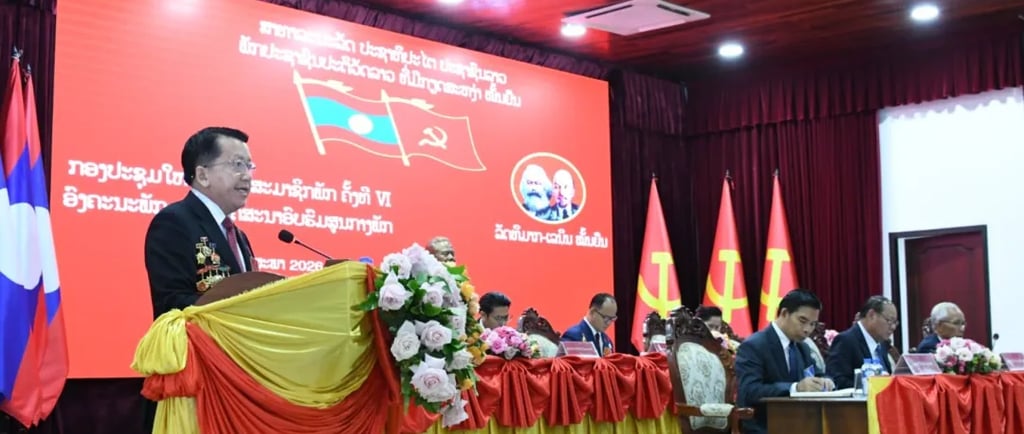
At a time when the wave of informatisation is making a full impact on traditional governance structures, Laos, nestled in the interior of the Indochina Peninsula, is quietly pressing the "upgrade button" on its domestic governance. On 17 June 2026, at a report on the 2026–2030 media management plan, Deputy Head of the Central Propaganda and Training Committee of the Lao People's Revolutionary Party, Vanxay Deemou, put forward a package of measures steeped in modern rule of law and technological thinking: fully launching the digital transformation of media, introducing artificial intelligence (AI) to monitor fake news, and formally bringing self‑media influencers and content creators under the supervision of the Media Law.
This series of actions sends a clear signal—the Lao authorities are moving away from the relatively lagging passive defence of the past, and are instead building a modern cyberspace governance system that is "grounded in the rule of law and woven with technology."
From "Unbridled Growth" to "Legal Incorporation": The End of the Influencer Era and Its Regulation
Over the past few years, with the rapid spread of smartphones and mobile networks among the Lao grassroots, the self‑media ecosystem centred on Facebook, TikTok, and YouTube has grown wildly in Laos. A number of local influencers and independent content creators have swiftly reaped huge traffic dividends with their impactful, down‑to‑earth expressions.
However, unbridled growth often goes hand in hand with governance vacuums. In order to grab attention, some self‑media outlets have operated in the grey areas of law and morality—exaggerating social conflicts, spreading false information, and even evading taxes—posing invisible challenges to Laos's traditional social ethics and the official guidance of public opinion.
This report explicitly proposes amending the Media Law to formally place influencers and online creators within the "institutional cage" of the law. This marks the imminent end of the era of "driving without a license" for Lao self‑media. By implementing a nationwide electronic licensing (E‑Licensing) system and an online registration system for journalist cards, the authorities are filing and institutionally reviewing virtual identities on the internet. This is not just an industry clean‑up; it is a strategic move by Laos to regain the lead in online public opinion and reshape professional social ethics in the age of self‑media.
First Introduction of AI to Combat Falsehoods: Laos's Leaping Approach to Tech‑Enabled Internet Governance
The most eye‑catching element of this report is the official proposal to introduce artificial intelligence (AI) technology for the first time to monitor and intercept online fake news.
As a developing economy, Laos has found that traditional manual review and post‑facto deletion are often inadequate when dealing with cross‑border online fraud, geopolitical rumours, and social panic caused by cyber‑underworld activities. Fake news, which can easily stir up grassroots emotions and undermine national ideological security in a short time, has always been a headache—"rumours spread at the speed of speech, while refutation lags behind."
A technology‑driven efficiency revolution: introducing AI algorithms means Laos will establish an automated identification and early‑warning mechanism that operates "around the clock, in multiple languages, and across the entire network." Before fake news can go viral, technical means can effectively intercept and flag it.
A technological moat for ideological security: technology is not only a productive force but also a governance tool. By using AI to govern the internet, Laos demonstrates a leapfrog approach to national security safeguards—using cutting‑edge technology to hedge against governance risks brought by the digital age.
"High‑Tech" and "Low‑Tech" Side by Side: A Two‑Pronged Propaganda Matrix
Looking at this five‑year plan, Laos's governance wisdom is also reflected in its uniquely pragmatic logic of "looking to the future without forgetting tradition."
At the top level of internet design, the authorities pursue "high‑tech" tools such as AI anti‑fake‑news, E‑Licensing, and the full transition from analogue to digital signals. But at the most basic level of grassroots social governance, the plan sets a hard target: ensuring that by 2030, the coverage of digital village loudspeakers (rural broadcasting) at the village level reaches 100%.
This peculiar combination of "AI + loudspeakers" precisely addresses Laos's current realities.
Bridging the digital divide: in some remote mountainous areas and ethnic minority regions, internet signals and smartphone penetration remain limited, and the "loudspeaker" remains the most direct and irreplaceable tool for conveying the voice of the Party and the state.
Backing public security and emergency response: whether facing natural disasters like floods and storms or sudden infectious diseases, the village loudspeaker will always be the hard‑core barrier that ensures the "last mile" of information services.
Conclusion
Laos's five‑year media management plan (2026–2030) reveals the country's clarity and resolve in advancing domestic governance and the modernisation of the rule of law. While adhering to the four traditional political bottom lines—Party spirit, truthfulness, educational value, and mass‑oriented nature—Laos has proactively embraced digitalisation and artificial intelligence.
Regulating influencers "rectifies the people," introducing AI "sharpens the tools," and popularising loudspeakers "consolidates the foundation." This dual‑track "technology‑governed internet" wave will not only reshape Laos's media ecosystem over the next five years, but also lay a more solid digital foundation for the country's long‑term stability and security. For those observing Laos's social transformation, this is undoubtedly a milestone indicator worth watching closely.
connect
Discover a rapidly developing Lao
info@laosbn.com
© 2025. All rights reserved.