
Laos is about to turn on the 'leverage' mode — this is the strongest economic signal of the year!
Laos 'leverage' mode
NEWS
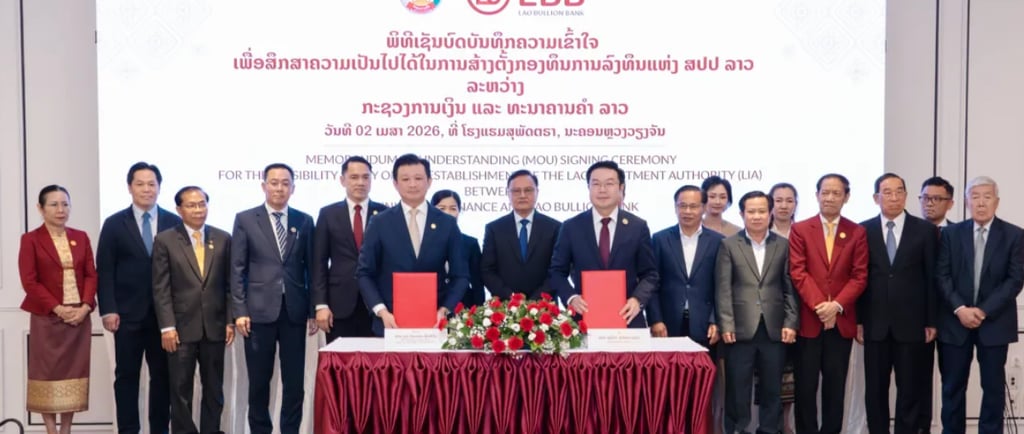
In April 2026, at the Souphattra Hotel in Vientiane, a historic moment took place. With the signing of a Memorandum of Understanding between the Ministry of Finance and the Lao Gold Bank, the planned "Lao Investment Fund" (LIA) was unveiled. This is not just the construction of a financial architecture; it is a milestone marking the Lao government's transition from traditional "physical asset management" to modern "capital operation" in its wealth management model.
According to publicly released information, Laos has officially embarked on its own sovereign wealth fund (SWF) path, following the models of Singapore's Temasek and Malaysia's Khazanah Nasional. What micro and macro transformations will this move bring to the Lao economy?
Turning Assets into Gold: Unleashing the Dormant Value of State Resources
For a long time, Laos has possessed abundant gold, minerals, and strategic materials, yet most of this wealth has remained "static reserves." The establishment of LIA is essentially a chemical reaction that turns "stock into flow."
In the past, gold ore and gold bars were just numbers in a warehouse; in the future, they will become productive capital. Through LIA, the government will be able to use its gold reserves as financial collateral to issue bonds.
This means Laos is beginning to learn how to use "financial leverage." By converting physical assets into liquid credit guarantees, Laos can attract more foreign direct investment (FDI) from international markets, directly relieving the long-standing liquidity pressures that have plagued the government.
Debt Pressure Relief Valve: From Passive Debt Servicing to Active Liquidity Management
The current macro pain points of Laos lie in debt servicing pressures and Kip volatility. The dual-mechanism operation of LIA precisely targets these two chronic problems.
The "stabilizer" function of the Strategic Stability Fund (SSF): Responsible for liquidity management and maintaining financial and currency stability. This acts like a "strategic reserve force" within Laos' financial system, capable of swiftly intervening when currency fluctuations or liquidity shortages occur, thereby strengthening confidence in the Kip.
Dr. Chanthon Sitthixay's mention of "easing debt servicing pressure" reveals that LIA will become a key platform for optimizing the national debt structure. By hedging debt costs with more orderly asset returns, Laos is trying to break out of the old cycle of "borrowing to build."
Internationalization of Governance: Winning Back Investor Confidence Through Transparency
For international investors, Laos' previous asset management model was often perceived as "low systematicity" and "lack of transparency." The emergence of LIA is a "standardized business card" extended to global markets.
Benchmarking best practices – explicitly drawing on mature models like Temasek means that LIA will adopt a performance-oriented, systematic, and transparent management model. This transformation will bring a significant "credibility premium." When Laos' wealth management begins to align with international standards, it will not only help Laos integrate more deeply into international financial markets but also effectively lower the country's overall financing costs.
Risk Perspective: Real-World Challenges Behind the Grand Vision
Any major financial innovation comes with risks. As LIA moves toward becoming the "Lao version of Temasek," it must confront micro and macro tests.
Market volatility and asset impairment risk – LIA plans to use gold as collateral for bond issuance. However, international gold prices are highly volatile. If gold prices drop sharply, the shrinking value of pledged assets could trigger credit default risks and even backfire on national finances.
Governance transparency and compliance challenges – Although the goal is to benchmark against Temasek, establishing an audit, supervision, and disclosure system that meets international standards cannot be achieved overnight. If a truly independent decision-making mechanism cannot be built during the 8-12 month preparation period, the fund may become a tool of administrative intervention, making it difficult to win over discerning international capital.
Macroeconomic headwinds – The global interest rate hike cycle has not yet fully receded. Issuing bonds to attract foreign capital at this time exposes Laos to extremely high financing costs. If the fund's return on equity (ROE) cannot cover its borrowing costs, the so-called "capital-driven national rejuvenation" could turn into a new debt burden.
The era of Laos "begging with a golden bowl" is about to end
According to the plan, the coming year will be a window for LIA to move from a legal framework to an operational regulatory system. This signals that the Lao government is playing a long game: shifting from "resource dependence" to "resilient capital." This is not just about short-term money; it is about ensuring sustainable returns on national wealth. The financialization of sovereign will marks the beginning of Laos presenting itself to global investors in a more mature, more professional, and more "partner-like" manner.
The launch of the Lao Investment Fund (LIA) declares that the era of Laos "begging with a golden bowl" is coming to an end. By converting gold and reserves into liquid, productive capital, Laos is attempting to forcibly anchor its economic stability amid uncertain global economic fluctuations. Whether this "stabilizing pillar" can be firmly planted in the next eight to twelve months will directly determine the quality of Laos' national wealth over the next decade.
connect
Discover a rapidly developing Lao
info@laosbn.com
© 2025. All rights reserved.