
Laos "Changes Formation": Media Transferred to CPC Propaganda Department, AI Fights Back Against Public Opinion, Cross‑Border Joint World Heritage Bid
LaosBN
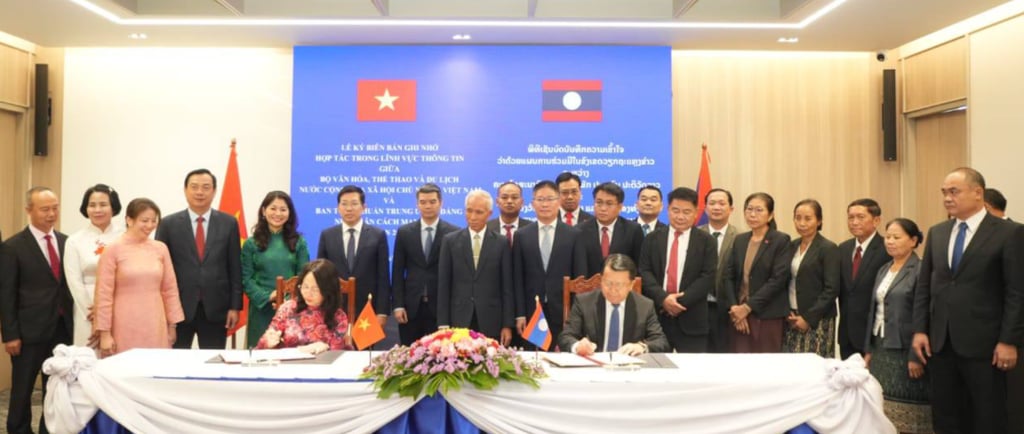
The Lao news on May 13 carried several highly penetrating signals: the five major media outlets that serve as the national mouthpiece officially changed hands, placed under the party's propaganda system; an AI‑powered "public opinion counterattack" backed by Vietnamese technology is about to launch; and even world heritage sites will be co‑managed with neighboring countries. Behind this series of major moves, what profound changes are taking place in Laos' governance logic?
Between the jungles of Southeast Asia and the Mekong River, Laos has always impressed people as stable and slow. Yet, on May 13, 2026, a series of seemingly scattered news items outlined a Laos that is rapidly "changing formation."
If we take today's news apart, it looks like just a few meetings and a few agreements. But if we piece them together, we see that Laos is engaged in a deep game – from political security to economic self‑rescue.
Consolidating the Base: The "Repositioning" and "Digital Upgrade" of the Mouthpiece
The most significant news today is the major reshuffle of Laos' media landscape.
Following directives from the Lao central authorities, five core media outlets originally under the Ministry of Information, Culture and Tourism – including the national television station, national radio station, and KPL News Agency – have been formally placed under the direct leadership of the Central Propaganda and Training Board. This is not just a change of administrative affiliation; it is a high concentration of governance power.
In the era of information fragmentation, Lao leaders have realized that the media is no longer just "entertainment and cultural services," but a "security line of defense." Moving the media from the government administrative system to the party system means that ideological control will shift from "indirect guidance" to "direct command."
An even more notable detail is the agreement signed between Laos and Vietnam, explicitly introducing AI technology to monitor and counter negative public opinion. This means that Laos' public opinion management is moving toward "intelligentization" – no longer passive explanation, but proactive action. This "cyber defense model" imported from Vietnam heralds a new phase in Laos' future social opinion environment: "pre‑emptive early warning and concentrated command."
Cross‑Border "Equity Participation": "Sovereignty‑Shared" Development of World Heritage Sites
Another intriguing piece of news is the Laos-Vietnam Culture and Tourism Agreement for 2026‑2030, which introduces a rare concept: a "cross‑border world heritage co‑management mechanism."
Laos' world heritage sites – such as Luang Prabang and Wat Phou – may in the future be "operated in partnership" with Vietnam.
This is a very clever move – Laos, trapped by its landlocked predicament, is engaging in a kind of "backdoor listing."
Breaking administrative barriers: "Co‑management" may lead to deep coordination between the two countries in areas such as visa mutual recognition and linked air routes. Imagine if a "Laos-Vietnam single tourist visa" were introduced in the future – one ticket, one visa to traverse the historical sites of both countries. Laos would directly "intercept" tourists from Vietnam's massive international visitor flow.
Huddling together for warmth: Instead of competing alone in the international tourism market, Laos has chosen to deeply embed itself in the "Greater Vietnam Tourism Circle." In essence, this exchanges partial management rights for access to Vietnam's mature global marketing network.
Governance Devolution: Administrative Tentacles Reach the "Nerve Endings"
In provincial news, Khammouane and Xayabury provinces are intensively carrying out "village‑to‑subdistrict" conversions or adding new administrative subdistricts.
Laos has long had a problem of overly broad governance – districts directly managing villages, leading to very loose administration. The strong push to add subdistrict‑level leadership is effectively the state driving "nails" into the grassroots.
This refinement of the administrative grid serves two purposes: on the one hand, to ensure smooth transmission of government decrees; on the other, to make investment attraction more precise. When an investor's factory or tourist attraction is located in a certain village, having a ready‑made "subdistrict government" to interface with brings efficiency and stability far beyond what existed before.
Strategic Balance: A Multi‑Pronged "Aid Game"
Looking at Laos' circle of friends today: Deputy Prime Minister Santiphab connects with Vietnamese financial aid; Deputy Prime Minister Thongsaly assesses World Bank loans; the Ministry of Education and Sports receives a US‑funded warehouse of supplies.
This demonstrates the extremely sober balancing act of Laos' leadership. It accepts US support for infrastructure and hard assets, aligns its top‑level financial procedures with Vietnam, and relies on the World Bank for livelihood security. Laos excels at "modularizing" aid from different sources – maximizing external resources to support domestic economic reforms without upsetting the geopolitical balance.
A "Harder, Sharper, More Proactive" Laos
What we are seeing now is no longer a Laos that simply goes with the flow. By consolidating the media to strengthen political resolve, adding AI to sharpen control precision, using cross‑border co‑management to channel economic vitality, and pushing administrative power downward to fortify the grassroots, Laos is building a "harder, sharper, more proactive" institutional shell for the next round of development after 2026.
For investors and observers, Laos' grand chess game has just set the pieces on the board. Under this trend of refined management, the space for past "wild growth" is shrinking, replaced by a "new normal" that is more institutionalized and transparent – but also more tightly controlled.(LaosBN)
connect
Discover a rapidly developing Lao
info@laosbn.com
© 2025. All rights reserved.