
80 Million Bombs Weighing on the Land: Clearing Mines to "Dig Out" Development Space for Northern Laos from Beneath Unexploded Ordnance
Laos Bombs
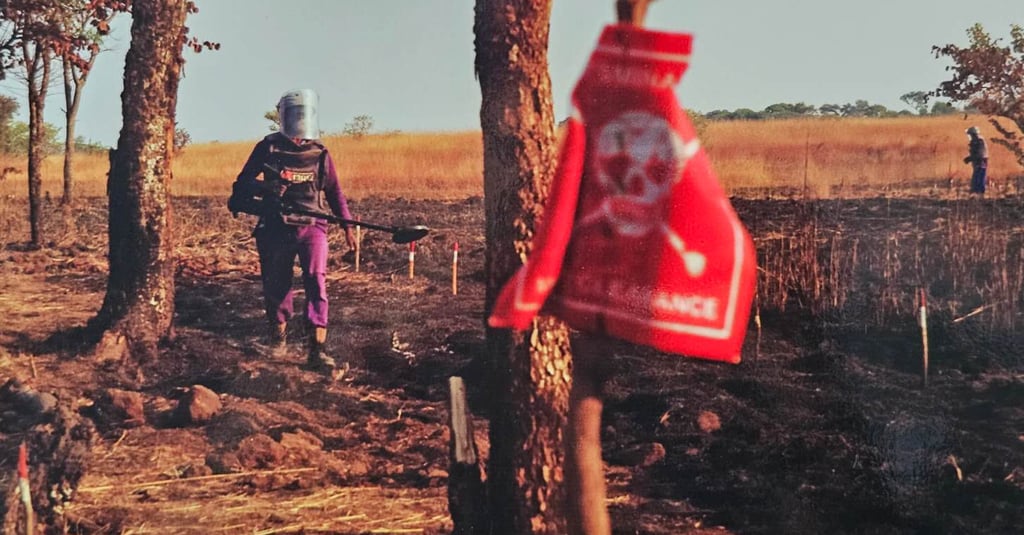
Recently, LaosBN traveled to southern Laos for work and visited the Plain of Jars Sites 1, 2, and 3 in Xieng Khouang Province. For historical reasons, only Site 1 is fully and safely open to the public. Site 2 is under development and remains largely closed to tourists due to the need for extensive mine clearance. Site 3 is semi‑open; the surrounding area is still an unexploded ordnance (UXO) zone, so visitors must be extremely cautious, strictly stay on paved stone paths, as the surrounding grasslands still pose a risk of triggering explosives.
80 million. That is the number of unexploded bombs the United States dropped on Laos during the Vietnam War. Half a century later, these cluster munitions, sleeping under rice paddies, forests, and village paths, still claim 40 to 50 lives every year — most of them children and farmers working in the fields.
The annual UXO clearance project summary meeting held in Khammouane Province on the 13th disclosed a set of data: over the past year, the MAG (Mines Advisory Group) clearance organization completed technical surveys covering over 11.11 million square meters in Bourapha District and other areas, cleared approximately 1.21 million square meters of land, conducted 926 spot clearance operations, and carried out 722 mobile destruction tasks. These numbers may seem dry, but they point to a long‑overlooked truth: in Laos, mine clearance has never been simply about dismantling bombs — it is a systematic project to transform "war legacies" into "development capital."
Between 1964 and 1973, the United States waged a "secret war" in Laos, dropping an estimated 2.7 million bombs. Of these, about 30% failed to detonate, scattering into approximately 80 million cluster bomblets that cover nearly one‑third of Laos' territory. These are not just cold statistics.
In central and eastern Lao provinces, countless families have lived for generations on the edges of "known contaminated areas." They know which mountain slopes to avoid, which fields can only be half‑planted. Every dry season, villagers use wooden sticks to probe their way as they cautiously enter "suspected safe zones" to farm. One wrong move — a hoe might strike a bomb that has been sleeping for half a century.
According to the Lao National Unexploded Ordnance Clearance Agency, UXO has caused over 20,000 casualties since 1975. Even today, more than fifty years after the war ended, about 40 to 50 people are still killed or injured each year by UXO. This is a heavy "negative asset" — it generates no returns, yet it continuously consumes lives, occupies land, and hampers development.
The 1.21 million square meters (approximately 120 hectares) of land cleared in the Khammouane project had long been left unused due to contamination risks. After the clearance teams completed their work, they issued "clean land certificates" to the village committees. This land will now be reused for rice and cassava cultivation, or for building schools and village roads.
This process, in essence, is an asset conversion: transforming unusable contaminated land, through investment in clearance, into productive, developable means of production. Every square meter of cleared land is "development capital" recovered from the legacy of war.
Similar conversions are happening on other dimensions: clearance teams prioritize cleaning areas around schools, village entrances, and water sources. The 722 mobile destruction operations meant 722 trips deep into remote villages to remove dangers, each one reducing the risk of children triggering explosives and decreasing the likelihood of families falling into poverty due to injury. Khammouane Province has in recent years become a hotspot for investment in wind power, mining, and logistics. The government's early completion of clean land certification removes safety obstacles for investment attraction and lowers the costs for businesses to set up. Transparent and efficient clearance projects also serve as a showcase for Laos' governance capacity. A good track record helps secure international aid in other fields such as education and health.
Interestingly, the funding to convert this "war legacy" does not all come from the side that left the legacy behind. The funding sources for this project form a "multi‑country puzzle": The United States (State Department and private foundations) provides funds for targeted cluster munition clearance, carrying a historical compensation character. The UK government focuses on large‑scale technical surveys and land clearance, maintaining its humanitarian presence in Southeast Asia. The Norwegian government and others fund mobile destruction and other flexible tasks. Lao local institutions provide coordination and support. The bombs were left by the US, but the money for clearing them comes from multiple countries. The "negative externality" of war is being shared by the international community, while the fruits of the conversion — safe land, healthy communities, smooth investment channels — stay in Laos.
On the technical side, the ratio of 11.11 million square meters of technical survey area to 1.21 million square meters of cleared area is roughly 10:1. This is a "funnel‑style" screening mechanism: first, use technical surveys to quickly rule out bomb‑free areas, then concentrate core manpower on "hot zones" confirmed to contain explosives, while using mobile destruction teams to cover blind spots beyond fixed bases. The essence of this logic is cost control — allocating limited clearance resources to the most dangerous places. For a country like Laos that depends on international aid for funding, this is the most pragmatic strategy, and it marks the evolution from "mine sweeping" to "precision mine clearance."
The Khammouane practice provides a model, but it is far from the finish line. Laos still has approximately 800,000 hectares of land awaiting clearance. The mine clearance task has only scratched the surface. Two structural problems stand out: First, the risk of funding gaps. The UK project only covers "April 2025 to March 2026," operating on an annual budget basis. If the next tranche of funding is not renewed, professional clearance teams face the risk of "layoffs if they stop work," and Laos' domestic clearance budget cannot fill the gap in the short term. Second, rising marginal costs. The easily accessible areas have largely been cleared. The remaining UXO is mostly hidden in limestone mountain areas — karst terrain, caves, steep slopes — where the difficulty and cost of clearance will rise significantly. According to MAG technical reports, future costs may increase by 30% to 50%. This means that the unit cost of extracting "development capital" from the "war legacy" is increasing.
The Khammouane clearance summary is, on the surface, a humanitarian report card, but in essence it is a financial statement of "asset conversion": investing funds from multiple countries and using precision technology to exchange, inch by inch, land weighed down by 80 million bombs for cultivated fields, school buildings, factories, and roads.
The essence of mine clearance has never been dismantling bombs — it is salvaging the possibility of Lao development from the wreckage of war. Every technical survey, every mobile destruction mission, every "clean land certificate" is a future redeemed from history. With the news that 800,000 hectares of land still await clearance, the progress in Khammouane may be just a small milestone on a very long road.
connect
Discover a rapidly developing Lao
info@laosbn.com
© 2025. All rights reserved.